A GARDEN THROUGH THE SEASONS: SPRING
In our previous article, What Is a Modern Garden?, we mentioned that year-round interest is one of the defining principles of contemporary garden design. However, a garden that remains beautiful throughout the seasons does not happen by chance. It begins at the garden design stage, when plants are selected not for what happens to be in bloom at the nursery today, but for how they will complement one another throughout the entire year.
In this article, we turn our attention to spring - the season when, after a long winter, we long most for light, colour, and the first flowers.
THE GARDEN AWAKES WITH THE FIRST COLOURS OF SPRING

Spring arrives in the garden long before the first perennials begin to flower. Even in early spring, bulbs bring the first vibrant colour back to the landscape after the muted tones of winter.
To extend the display beyond a brief two-week spectacle, combine spring bulbs with varieties that bloom at different times and heights.
Tulips are only part of the story. Snowdrops, crocuses, daffodils, grape hyacinths and fritillaries create layered spring plantings that evolve throughout the season. The earliest flowers are gradually followed by taller species, allowing the garden to change continuously.
This succession of flowering is one of the fundamental principles of professional garden design.
PERENNIALS BRING DEPTH TO SPRING

As the spring bulbs begin to fade, perennials take over, ensuring the garden remains vibrant and full of life.
Among the finest plants for spring are Brunnera macrophylla, Helleborus, Pulsatilla vulgaris, Phlox divaricata, Viola odorata, Omphalodes verna, Anemone sylvestris and Primula vulgaris. Together, they extend the flowering season while adding texture, volume and a natural character to the planting.
Fragaria vesca is another wonderful example. Its delicate white flowers create a romantic atmosphere in spring, followed by bright red berries. At the same time, its fresh green foliage forms an attractive groundcover beneath trees and shrubs throughout the growing season.
SPRING COLOUR COMES FROM MORE THAN FLOWERS

When we think of spring colour, flowers are usually the first thing that comes to mind. Yet in a professionally designed garden, colour and vitality come from much more than flowering alone.
Ornamental bark, branch structure and fresh new growth all contribute to the garden's spring display. Prunus serrula, the Tibetan cherry, is admired for its glossy mahogany-red bark, which remains striking throughout the year. Betula utilis adds brightness to the landscape with its brilliant white trunk, standing out beautifully against the fresh greens of spring.
Another distinctive feature is Hamamelis × intermedia, whose elegantly twisted branches provide architectural interest even before the leaves emerge. Meanwhile, species of Cornus and Euonymus produce vibrant new shoots in spring, while many conifers display fresh growth in noticeably lighter shades than the previous year's needles.
These subtle details bring colour, texture and vitality to the garden long before summer reaches its peak. Even while most perennials are only just emerging, the garden already feels alive. A truly ornamental garden is never defined by flowering alone - it evolves continuously, revealing new layers of beauty with every season.
FLOWERING TREES MARK THE CULMINATION OF SPRING
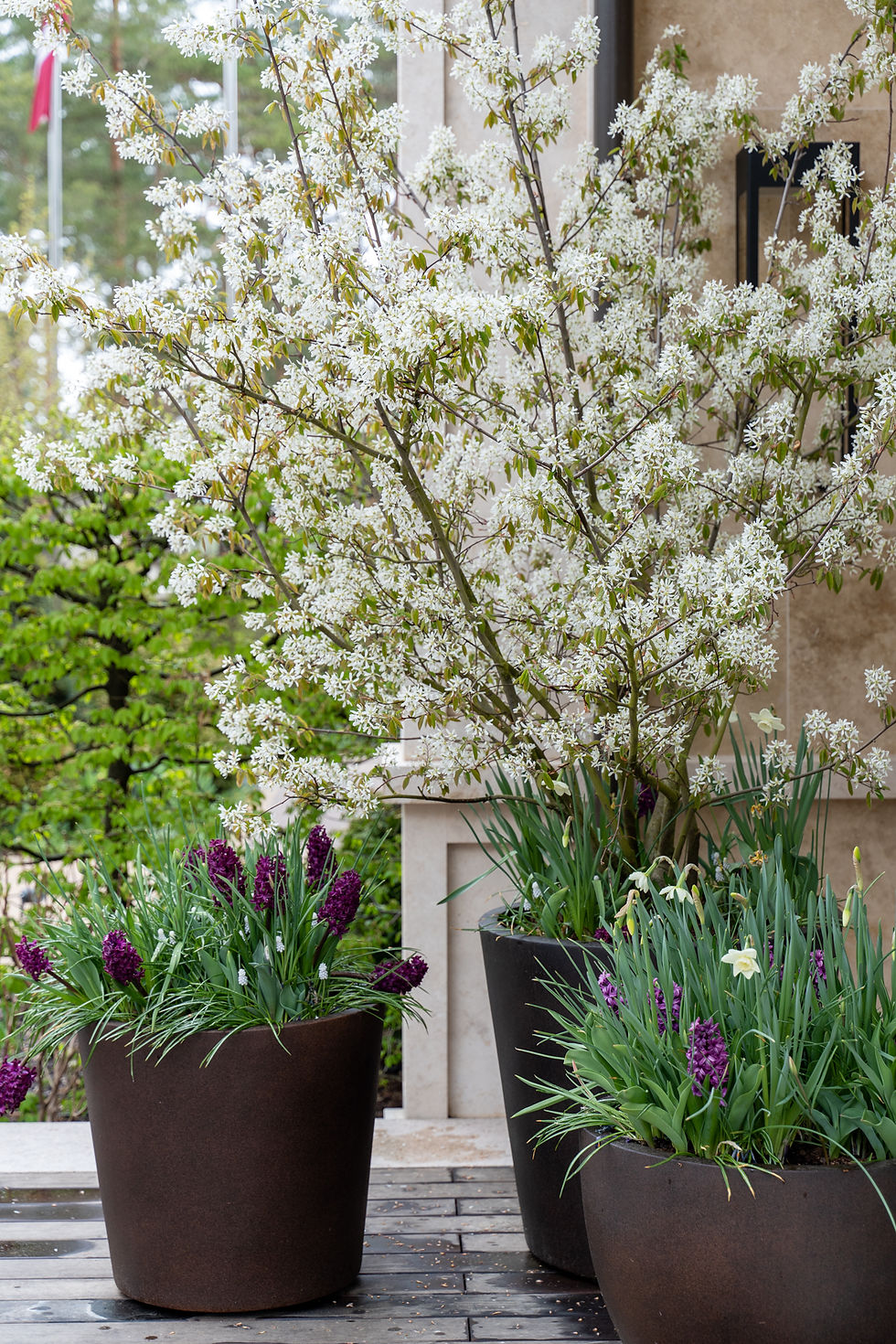
If spring bulbs and perennials create the season's opening act, flowering trees provide its most spectacular display.
They introduce height and structure, fill the garden with blossom and fragrance, and become some of the most memorable features of spring.
Among the finest are the flowering cherries. By carefully selecting cultivars, it is possible to enjoy blossom for almost two months.
Prunus 'Accolade' flowers first, followed by the upright Prunus 'Amanogawa', and the richly double-flowered Prunus 'Kanzan'. Where space allows, this succession creates an extraordinary display of pink blossom throughout much of spring.
One of the most elegant small trees is Amelanchier. In spring, its branches are covered with delicate white flowers. Summer brings clusters of dark, sweet berries, while autumn transforms the foliage into brilliant shades of orange and red. It is an excellent example of a tree that offers ornamental value across multiple seasons.
Ornamental crab apples (Malus) are equally rewarding. After their abundant spring blossom, they retain colourful fruit throughout summer and autumn, extending their decorative appeal long after flowering has finished. Particularly reliable cultivars include Malus 'Red Sentinel', Malus 'Evereste' and Malus 'Rudolph'.
Magnolias can also provide an exceptionally long flowering season when several cultivars are planted together. Magnolia stellata opens first, followed by Magnolia loebneri 'Merrill' and 'Leonard Messel'. The season then reaches its peak with Magnolia × soulangeana and Magnolia 'Susan'. The latter flowers for longer than most magnolias and, under favourable conditions, may bloom again later in summer. Although each cultivar flowers for around three weeks, combining several magnolias can extend the overall display for many weeks, creating one of spring's most memorable spectacles.
RHODODENDRONS – AN ESSENTIAL FEATURE OF THE SPRING GARDEN

Evergreen rhododendrons are among the most familiar shrubs in northern gardens. They retain their foliage year-round, forming dense, architectural masses that remain an important part of the garden composition even in winter. During flowering, they produce spectacular clouds of bloom, while for the rest of the season they provide a calm, evergreen backdrop for surrounding plantings.
Choosing the right location is essential. Evergreen rhododendrons perform best in light shade, where they are protected from the intense winter and early spring sun. Bright sunshine in February and March can cause the leaves to dry out while the roots remain frozen in the ground.
Deciduous rhododendrons, on the other hand, offer an entirely different range of possibilities. Since they shed their leaves in winter, they can be planted successfully in full sun. Their flowers are exceptionally vivid, with shades of yellow, orange, pink and red that often appear almost luminous against the fresh greens of spring.
Beyond their remarkable colours, many deciduous rhododendrons are also prized for their rich, sweet fragrance, which fills the garden during their flowering season.
Among the deciduous rhododendrons, we particularly recommend Rhododendron 'Homebush', 'Jolie Madame', 'Daviesii' and 'Ausma'. Reliable evergreen cultivars include Rhododendron 'Cunningham's White', 'Roseum Elegans' and 'Grandiflorum', all valued for their excellent winter hardiness, abundant flowering and proven performance in the northern European climate.
A WELL-DESIGNED GARDEN DOES NOT BEGIN AT THE NURSERY
One of the most common mistakes is choosing plants simply because they happen to be in flower when visiting a nursery.
It is difficult to resist a magnificent magnolia or a rhododendron in full bloom. Yet a garden lives far longer than any single flowering season.
That is why landscape architects always begin with a comprehensive garden design. Only then are plants selected for the way they complement one another throughout spring, summer, autumn and winter.
Even if you are designing your own garden, it is worth creating a simple seasonal planting plan before buying plants. Consider what will flower each month, which plants will provide attractive foliage, which will bring autumn colour, and which will retain their structure through winter. This thoughtful approach helps avoid impulsive purchases and allows you to create a harmonious, balanced and sustainable garden step by step.
COMING NEXT: SUMMER
Spring may be one of the most colourful moments in the garden, but it is only the beginning of the season.
In the next article, we will explore how to plan plantings that remain beautiful throughout summer—from the first peonies in bloom to richly layered perennial borders, ornamental grasses and carefully selected trees that continue to shape the garden well into the second half of the season.